Publications
Publications on hyperbolic PDE control, backstepping, Markov-jumping systems, neural operators, and intelligent transportation systems.
My full list of papers are in Google Scholar
2026
- PreprintRobust Stabilization of Linear Markov-Jumping Hyperbolic PDEs with Boundary Input DelayYihuai Zhang, Yidan Cao, Huan Yu, and Lu LiuarXiv preprint arXiv:2607.02081, Jul 2026
This paper studies the robust stabilization of 2 × 2 linear hyperbolic partial differential equations (PDEs) with Markov-jumping parameters and boundary input delay. The main challenge arises from the simultaneous presence of stochastic parameter variations and input delay, which complicates both the stability analysis and controller design. To address this issue, a nominal delay-compensating backstepping controller is first designed for a fixed nominal system. Applying the nominal transformation to the stochastic system yields a target system with additional perturbation terms induced by parameter mismatch. A mode-independent Lyapunov functional is then constructed to establish a pathwise exponential estimate, which directly implies mean-square exponential stability under an explicit small-mismatch condition. The proposed analysis provides a direct robustness certificate for nominal delay compensation without using mode-dependent Lyapunov functionals. Finally, we present simulation results and discuss how the conservative small-mismatch condition should be interpreted for the numerical example.
@article{zhang2026robust, title = {Robust Stabilization of Linear Markov-Jumping Hyperbolic PDEs with Boundary Input Delay}, author = {Zhang, Yihuai and Cao, Yidan and Yu, Huan and Liu, Lu}, journal = {arXiv preprint arXiv:2607.02081}, month = jul, year = {2026}, eprint = {2607.02081}, archiveprefix = {arXiv}, primaryclass = {eess.SY}, } - PreprintEvent-Triggered Gain Scheduling of 2 x 2 Linear Hyperbolic PDEs via Neural Operators (Full Version)Yihuai Zhang, Jean Auriol, Nicolas Espitia, and Huan YuarXiv preprint arXiv:2606.31052, Jun 2026
This paper introduces a new framework for event-triggered gain scheduling applied to linear hyperbolic partial differential equations (PDEs) with time- and space-varying coefficients. The approach leverages neural operators to address the challenges of real-time control in such systems. At each triggering time, the control input is designed using the classical static backstepping control law, while the gains of the boundary controller are updated according to the triggering mechanism and the spatial variation of the coefficients. Neural operators are employed to learn the mapping between the system parameters in the PDEs and the corresponding backstepping kernels. By integrating neural operators into the event-triggered framework, we eliminate the need to repeatedly solve complex kernel equations at every triggering instant, thereby reducing computational overhead while ensuring closed-loop stability. The proposed method is validated through theoretical analysis and numerical simulations, demonstrating its effectiveness and strong potential for real-time control of time-varying hyperbolic PDE systems.
@article{zhang2026eventtriggered, title = {Event-Triggered Gain Scheduling of 2 x 2 Linear Hyperbolic PDEs via Neural Operators (Full Version)}, author = {Zhang, Yihuai and Auriol, Jean and Espitia, Nicolas and Yu, Huan}, journal = {arXiv preprint arXiv:2606.31052}, month = jun, year = {2026}, eprint = {2606.31052}, archiveprefix = {arXiv}, primaryclass = {eess.SY}, } - PreprintCooperative Switched Formation Control of Autonomous Vehicles: An Event-triggered Approach to Input Saturation and Time-delay ChallengesZiming Wang, Guanxuan Jiang, Yihuai Zhang, Karl H. Johansson, and 1 more authorarXiv preprint arXiv:2606.11971, Jun 2026
This paper presents a collaborative adaptive formation control framework for autonomous vehicles (AVs) that explicitly handles system uncertainties, input saturation, and communication delays. To overcome the inherent physical torque limits of steering and braking actuators, an input saturation compensation mechanism is introduced to render nonlinearities tractable and improve control reliability. Additionally, a delay-compensating auxiliary system is designed to mitigate the effects of communication delays and reduce tracking errors. Our framework incorporates a dynamic-threshold event-triggered control strategy to optimize resource usage. Uncertainty observers and symmetric barrier Lyapunov functions are developed to ensure robust and safe formation maneuvers. Finally, the effectiveness of the proposed approach is validated through numerical simulations of vehicle formations, complemented by a 3D visualization video demonstrating the dynamic fleet reconfiguration process.
@article{wang2026cooperative, title = {Cooperative Switched Formation Control of Autonomous Vehicles: An Event-triggered Approach to Input Saturation and Time-delay Challenges}, author = {Wang, Ziming and Jiang, Guanxuan and Zhang, Yihuai and Johansson, Karl H. and Rikos, Apostolos I.}, journal = {arXiv preprint arXiv:2606.11971}, month = jun, year = {2026}, eprint = {2606.11971}, archiveprefix = {arXiv}, primaryclass = {eess.SY}, } - Automatica
 Operator Learning for Robust Stabilization of Linear Markov-Jumping Hyperbolic PDEsYihuai Zhang, Jean Auriol, and Huan YuAutomatica, Mar 2026
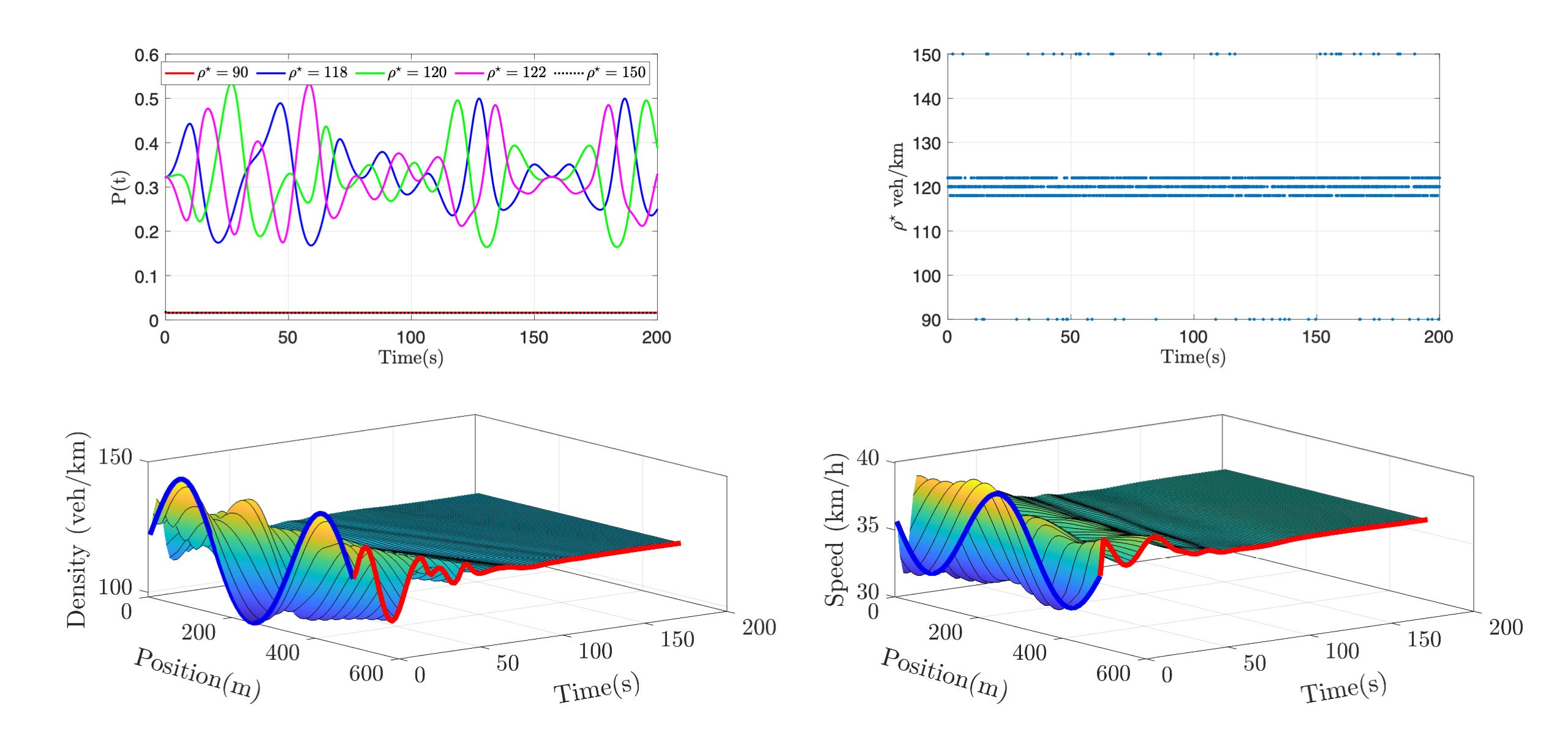
This paper addresses the problem of robust stabilization for linear hyperbolic partial differential equations (PDEs) with Markov-jumping parameter uncertainty. We consider a 2 × 2 heterogeneous hyperbolic PDE and propose a control law using operator learning and the backstepping method. Specifically, the backstepping kernels used to construct the control law are approximated with neural operators (NO) in order to improve computational efficiency. The key challenge lies in deriving the stability conditions with respect to the Markov-jumping parameter uncertainty and NO approximation errors. The mean-square exponential stability of the stochastic system is achieved through Lyapunov analysis, indicating that the system can be stabilized if the random parameters are sufficiently close to the nominal parameters on average and NO approximation errors are small enough. The theoretical results are applied to freeway traffic control under stochastic upstream demands and then validated through numerical simulations.
@article{zhang2024operator, title = {Operator Learning for Robust Stabilization of Linear Markov-Jumping Hyperbolic PDEs}, author = {Zhang, Yihuai and Auriol, Jean and Yu, Huan}, journal = {Automatica}, volume = {185}, pages = {112809}, month = mar, year = {2026}, doi = {10.1016/j.automatica.2025.112809}, eprint = {2412.09019}, archiveprefix = {arXiv}, primaryclass = {eess.SY}, publisher = {Elsevier} } - IEEE TITSEvent-Triggered Regulation of Mixed-Autonomy Traffic Under Varying Traffic ConditionsYihuai Zhang, and Huan YuIEEE Transactions on Intelligent Transportation Systems, Jan 2026
Modeling and congestion mitigation of mixed-autonomy traffic systems consisting of human-driven and autonomous vehicles have become increasingly important. This paper develops an event-triggered control framework for mitigating congestion in systems modeled by an extended Aw-Rascle-Zhang formulation of coupled 4 × 4 hyperbolic partial differential equations. Ramp metering is used as the boundary actuation mechanism. To reduce computational and communication burdens while avoiding excessive ramp-signal changes, we design a backstepping-based event-triggered controller together with an observer-based formulation for limited sensing. Lyapunov analysis ensures exponential convergence and avoidance of Zeno behavior. Simulations cover varying autonomous-vehicle penetration rates, spacing policies, demand levels, and non-recurrent congestion patterns. The controller stabilizes mixed traffic with far fewer updates than continuous backstepping control, while higher autonomous-vehicle penetration produces longer release times and fewer triggering events.
@article{Zhang2026event,
  author = {Zhang, Yihuai and Yu, Huan},
  journal = {IEEE Transactions on Intelligent Transportation Systems},
  title = {Event-Triggered Regulation of Mixed-Autonomy Traffic Under Varying Traffic Conditions},
  year = {2026},
  volume = {27},
  number = {1},
  month = jan,
  pages = {816--830},
  doi = {10.1109/TITS.2025.3632297},
  eprint = {2511.13206},
  archiveprefix = {arXiv},
  publisher = {IEEE}
}

2025
- IFAC CPDE 2025Neural Operators for Adaptive Control of Traffic Flow ModelsKaijing Lyu, Junmin Wang, Yihuai Zhang, and Huan YuIFAC-PapersOnLine, Jan 2025
The uncertainty in human driving behaviors leads to stop-and-go instabilities in freeway traffic. The traffic dynamics are typically modeled by the Aw-Rascle-Zhang (ARZ) partial differential equation (PDE) models, in which the relaxation time parameter is usually unknown or hard to calibrate. This paper proposes an adaptive boundary control design based on neural operators (NO) for the ARZ PDE systems. In adaptive control, solving the backstepping kernel PDEs online requires significant computational resources at each timestep to update estimates of the unknown system parameters. To address this, we employ DeepONet to efficiently map model parameters to kernel functions. Simulations show that DeepONet generates kernel solutions nearly two orders of magnitude faster than traditional solvers while maintaining a loss on the order of 10^-2. Lyapunov analysis further validates the stability of the system when using DeepONet-approximated kernels in the adaptive controller. This result suggests that neural operators can significantly accelerate the acquisition of adaptive controllers for traffic control.
@article{lyu2025neural, title = {Neural Operators for Adaptive Control of Traffic Flow Models}, author = {Lyu, Kaijing and Wang, Junmin and Zhang, Yihuai and Yu, Huan}, journal = {IFAC-PapersOnLine}, volume = {59}, number = {8}, pages = {13--18}, doi = {10.1016/j.ifacol.2025.08.059}, eprint = {2505.07353}, archiveprefix = {arXiv}, primaryclass = {math.OC}, publisher = {Elsevier}, year = {2025} } - PreprintAdaptive Event-triggered Formation Control of Autonomous VehiclesZiming Wang, Yihuai Zhang, Chenguang Zhao, and Huan YuarXiv preprint arXiv:2506.06746, Jun 2025
This paper presents adaptive event-triggered formation control strategies for autonomous vehicles (AVs) subject to longitudinal and lateral motion uncertainties. The proposed framework explores various vehicular formations to enable safe and efficient navigation in complex traffic scenarios, such as narrow passages, collaborative obstacle avoidance, and adaptation to cut-in maneuvers. In contrast to conventional platoon control strategies that rely on predefined communication topologies and continuous state transmission, our approach employs a sampling-based observer to reconstruct vehicle dynamics. Building upon an adaptive backstepping continuous-time controller, we design three distinct event-triggered mechanisms, each offering a different trade-off between formation tracking performance and control efficiency by reducing the frequency of control signal updates. A Lyapunov-based stability analysis is conducted to guarantee bounded tracking errors and to avoid Zeno behavior. Finally, the proposed event-triggered controllers are validated through simulations of vehicular formation in three scenarios, highlighting their impact on traffic safety and mobility.
@article{wang2025adaptive, title = {Adaptive Event-triggered Formation Control of Autonomous Vehicles}, author = {Wang, Ziming and Zhang, Yihuai and Zhao, Chenguang and Yu, Huan}, journal = {arXiv preprint arXiv:2506.06746}, month = jun, eprint = {2506.06746}, archiveprefix = {arXiv}, primaryclass = {eess.SY}, year = {2025} } - IFAC CPDE 2025Neural-Operator Control for Traffic Flow Models with Stochastic DemandYihuai Zhang, Jean Auriol, and Huan YuIFAC-PapersOnLine, Jun 2025
In this paper, we investigated the robust stabilization problem for Aw-Rascle-Zhang (ARZ) traffic systems considering stochastic traffic demand from the upstream boundary represented by a Markov-jumping process. We propose a control law that combines operator learning with the backstepping control method. To enhance computational efficiency, the backstepping kernels used in the control law are approximated by neural operators (NOs). We demonstrate that mean-square exponential stability of the closed-loop system, with a nominal neural operator-approximated backstepping control law, can be achieved through Lyapunov analysis. The theoretical results are validated by numerical simulations.
@article{zhang2025neural, title = {Neural-Operator Control for Traffic Flow Models with Stochastic Demand}, journal = {IFAC-PapersOnLine}, volume = {59}, number = {8}, pages = {1-6}, author = {Zhang, Yihuai and Auriol, Jean and Yu, Huan}, doi = {10.1016/j.ifacol.2025.08.057}, publisher = {Elsevier}, year = {2025} } - TR-C
 Mitigating stop-and-go traffic congestion with operator learningYihuai Zhang, Ruiguo Zhong, and Huan YuTransportation Research Part C: Emerging Technologies, Jan 2025
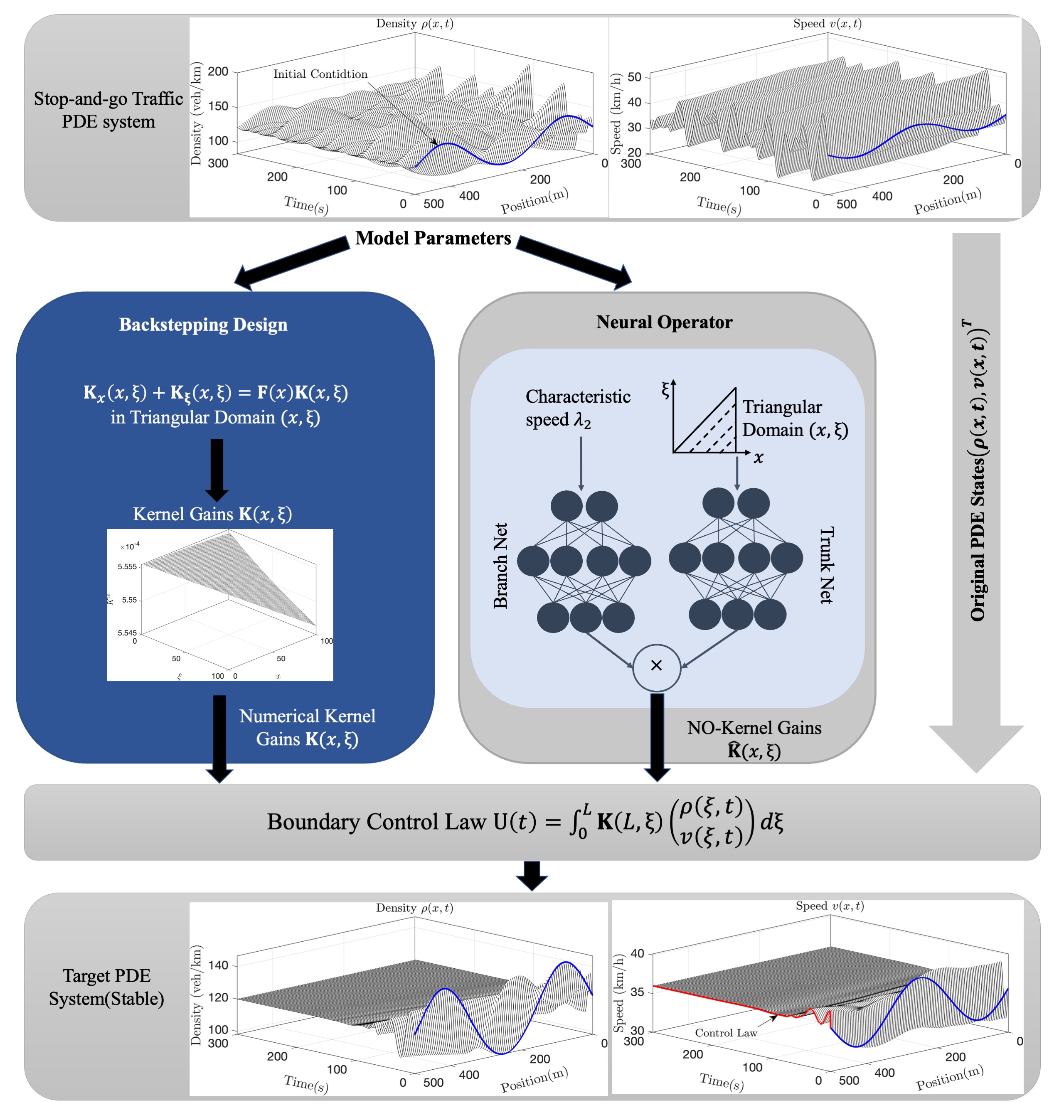
This paper presents a novel neural operator learning framework for designing boundary control to mitigate stop-and-go congestion on freeways. The freeway traffic dynamics are described by second-order coupled hyperbolic partial differential equations (PDEs), i.e. the Aw–Rascle–Zhang (ARZ) macroscopic traffic flow model. The proposed framework learns feedback boundary control strategies from the closed-loop PDE solution using backstepping controllers, which are widely employed for boundary stabilization of PDE systems. The PDE backstepping control design is time-consuming and requires intensive depth of expertise, since it involves constructing and solving backstepping control kernels. Existing machine learning methods for solving PDE control problems, such as physics-informed neural networks (PINNs) and reinforcement learning (RL), face the challenge of retraining when PDE system parameters and initial conditions change. To address these challenges, we present neural operator (NO) learning schemes for the ARZ traffic system that not only ensure closed-loop stability robust to parameter and initial condition variations but also accelerate boundary controller computation. The first scheme embeds NO-approximated control gain kernels within a analytical state feedback backstepping controller, while the second one directly learns a boundary control law from functional mapping between model parameters to closed-loop PDE solution. The stability guarantee of the NO-approximated control laws is obtained using Lyapunov analysis. We further propose the physics-informed neural operator (PINO) to reduce the reliance on extensive training data. The performance of the NO schemes is evaluated by simulated and real traffic data, compared with the benchmark backstepping controller, a Proportional Integral (PI) controller, and a PINN-based controller. The NO-approximated methods achieve a computational speedup of approximately 300 times with only a 1% error trade-off compared to the backstepping controller, while outperforming the other two controllers in both accuracy and computational efficiency. The robustness of the NO schemes is validated using real traffic data, and tested across various initial traffic conditions and demand scenarios. The results show that neural operators can significantly expedite and simplify the process of obtaining controllers for traffic PDE systems with great potential application for traffic management.
@article{zhang2025mitigating, title = {Mitigating stop-and-go traffic congestion with operator learning}, author = {Zhang, Yihuai and Zhong, Ruiguo and Yu, Huan}, journal = {Transportation Research Part C: Emerging Technologies}, volume = {170}, pages = {104928}, month = jan, year = {2025}, doi = {10.1016/j.trc.2024.104928}, eprint = {2411.05866}, archiveprefix = {arXiv}, publisher = {Elsevier} } - AutomaticaNeural operators for adaptive control of freeway trafficKaijing Lv, Junmin Wang, Yihuai Zhang, and Huan YuAutomatica, Dec 2025
The uncertainty in human driving behaviors leads to stop-and-go traffic congestion on freeways. The freeway traffic dynamics are governed by Aw-Rascle-Zhang (ARZ) traffic partial differential equation (PDE) models with unknown relaxation time. Motivated by the adaptive traffic control problem, this paper presents a neural-operator-based adaptive boundary control design for coupled 2 × 2 hyperbolic systems with uncertain spatially varying in-domain coefficients and boundary parameter. In traditional adaptive control for PDEs, solving the backstepping kernel online can be computationally intensive because coefficient estimates are updated at each time step. To address this challenge, we use DeepONet to learn the mapping from system parameters to kernel functions. We extend operator learning from scalar PDEs to a class of first-order coupled 2 × 2 hyperbolic kernel equations. DeepONet is nearly two orders of magnitude faster than traditional PDE solvers for generating kernel functions while maintaining a loss on the order of 10^-3. We rigorously establish system stability via Lyapunov analysis when employing DeepONet-approximated kernels in the adaptive controller. The proposed approach guarantees stability, does not rely on initial values, and enhances the real-time applicability of adaptive control for mitigating traffic congestion.
@article{lv2024neural,
  title = {Neural operators for adaptive control of freeway traffic},
  author = {Lv, Kaijing and Wang, Junmin and Zhang, Yihuai and Yu, Huan},
  journal = {Automatica},
  volume = {182},
  pages = {112553},
  month = dec,
  year = {2025},
  issn = {0005-1098},
  doi = {10.1016/j.automatica.2025.112553},
  eprint = {2410.20708},
  archiveprefix = {arXiv},
  publisher = {Elsevier}
}

2024
- Automatica
 Mean-square exponential stabilization of mixed-autonomy traffic PDE systemYihuai Zhang, Huan Yu, Jean Auriol, and Mike PereiraAutomatica, Dec 2024
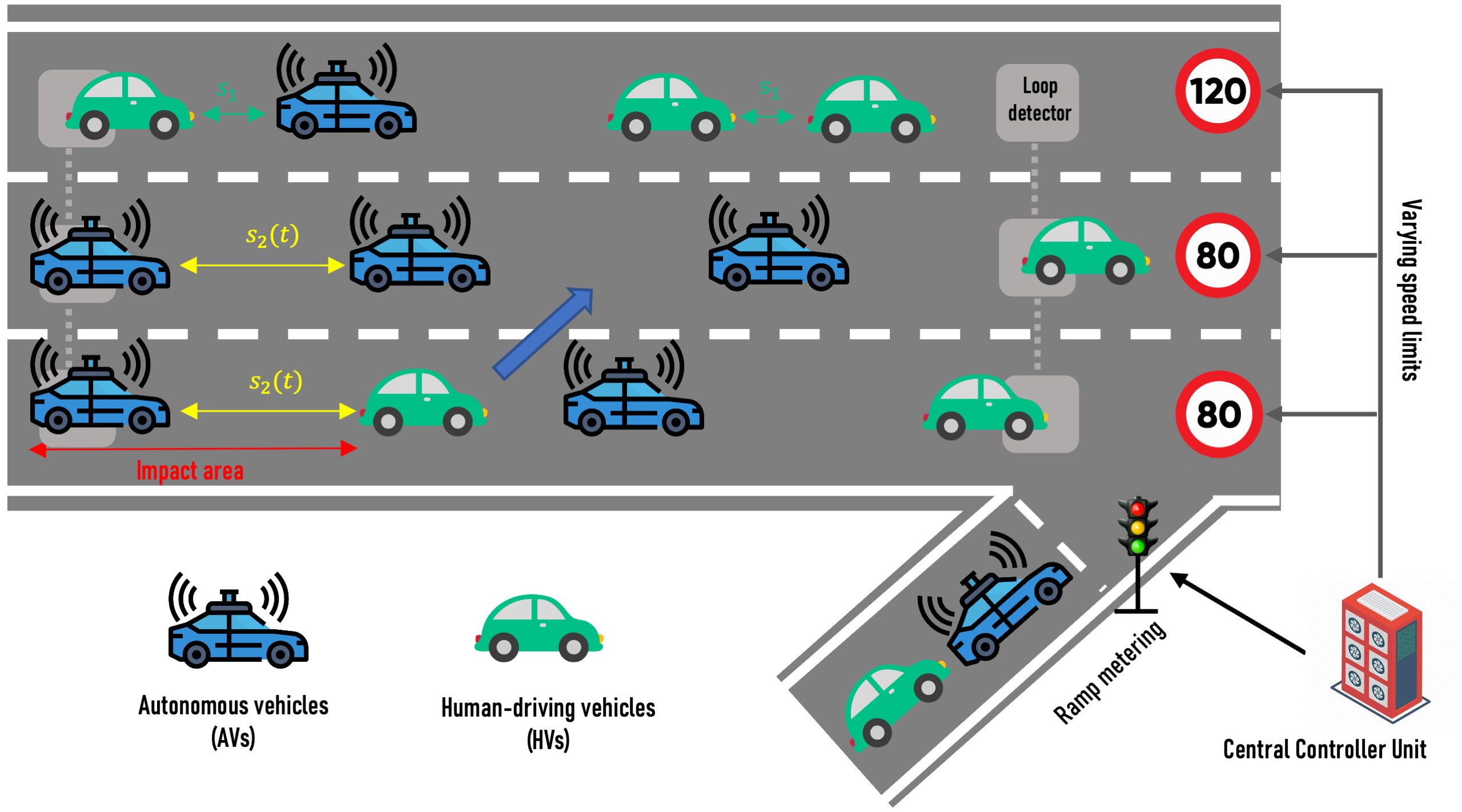
Control of mixed-autonomy traffic where Human-driven Vehicles (HVs) and Autonomous Vehicles (AVs) coexist on the road has gained increasing attention over the recent decades. This paper addresses the boundary stabilization problem for mixed traffic on freeways. The traffic dynamics are described by uncertain coupled hyperbolic partial differential equations (PDEs) with Markov jumping parameters, which aim to address the distinctive driving strategies between AVs and HVs. Considering that the spacing policies of AVs vary in mixed traffic, the stochastic impact area of AVs is governed by a continuous Markov chain. The interactions between HVs and AVs such as overtaking or lane changing are mainly induced by impact areas. Using backstepping design, we develop a full-state feedback boundary control law to stabilize the deterministic system (nominal system). Applying Lyapunov analysis, we demonstrate that the nominal backstepping control law is able to stabilize the traffic system with Markov jumping parameters, provided the nominal parameters are sufficiently close to the stochastic ones on average. The mean-square exponential stability conditions are derived, and the results are validated by numerical simulations.
@article{zhang2024mean, title = {Mean-square exponential stabilization of mixed-autonomy traffic PDE system}, author = {Zhang, Yihuai and Yu, Huan and Auriol, Jean and Pereira, Mike}, journal = {Automatica}, volume = {170}, pages = {111859}, month = dec, year = {2024}, doi = {10.1016/j.automatica.2024.111859}, eprint = {2310.15547}, archiveprefix = {arXiv}, publisher = {Pergamon} } - L4DCNeural operators for boundary stabilization of stop-and-go trafficYihuai Zhang, Ruiguo Zhong, and Huan YuIn Proceedings of the 6th Annual Learning for Dynamics & Control Conference, Jul 2024
This paper introduces a novel approach to PDE boundary control design using neural operators to alleviate stop-and-go traffic instabilities. The traffic dynamics are described by the Aw-Rascle-Zhang model, which consists of second-order coupled hyperbolic partial differential equations. The backstepping method is widely used for boundary control of such systems, but constructing and solving the associated control kernels requires specialist expertise and can be time-consuming. To overcome these challenges, we present two neural operator learning schemes: one embeds neural-operator-approximated gain kernels within a predefined backstepping controller, while the other directly learns a boundary control law. Lyapunov analysis evaluates the stability of both approaches and establishes practical stability under suitable approximation accuracy conditions. Simulations compare the neural operator controllers with a PDE backstepping controller and a proportional-integral controller. The neural-operator methods consistently outperform the proportional-integral controller and substantially accelerate computation, simplifying the acquisition of boundary controllers for freeway traffic stabilization.
@inproceedings{zhang2024neural, title = {Neural operators for boundary stabilization of stop-and-go traffic}, author = {Zhang, Yihuai and Zhong, Ruiguo and Yu, Huan}, booktitle = {Proceedings of the 6th Annual Learning for Dynamics \& Control Conference}, volume = {242}, series = {Proceedings of Machine Learning Research}, pages = {554--565}, month = jul, year = {2024}, publisher = {PMLR} } - ACCRobust boundary stabilization of stochastic hyperbolic PDEsYihuai Zhang, Jean Auriol, and Huan YuIn 2024 American Control Conference (ACC), Jul 2024
This paper proposes a backstepping boundary control design for robust stabilization of linear first-order coupled hyperbolic partial differential equations (PDEs) with Markov-jumping parameters. The system consists of 4 × 4 coupled hyperbolic PDEs whose first three characteristic speeds are positive and whose last characteristic speed is negative. We first design a full-state feedback boundary control law for a nominal deterministic system using the backstepping method. Lyapunov analysis then shows that the nominal controller stabilizes the PDE system with Markov-jumping parameters when the nominal parameters are sufficiently close to the stochastic ones on average. Mean-square exponential stability conditions are derived theoretically and validated through numerical simulations.
@inproceedings{zhang2024robust, title = {Robust boundary stabilization of stochastic hyperbolic PDEs}, author = {Zhang, Yihuai and Auriol, Jean and Yu, Huan}, booktitle = {2024 American Control Conference (ACC)}, pages = {5333--5338}, month = jul, year = {2024}, doi = {10.23919/ACC60939.2024.10644228}, eprint = {2312.16636}, archiveprefix = {arXiv}, primaryclass = {eess.SY}, publisher = {IEEE} } - CDCEvent-Triggered Boundary Control of Mixed-Autonomy TrafficYihuai Zhang, and Huan YuIn 2024 IEEE 63rd Conference on Decision and Control (CDC), Dec 2024
This paper studies boundary control of mixed-autonomy traffic systems consisting of human-driven and autonomous vehicles. The mixed traffic dynamics are modeled by 4 × 4 hyperbolic partial differential equations that describe the propagation of vehicle densities, inter-class interactions, and average velocity. Because ramp-metering signals and variable speed limits cannot be updated continuously in practice, we propose a dynamic event-triggered implementation of a PDE backstepping controller. Lyapunov analysis establishes exponential stability of the closed-loop system and excludes Zeno behavior. Numerical simulations demonstrate the effectiveness of the controller and show how autonomous-vehicle spacing policies affect the event-triggering mechanism.
@inproceedings{10886427,
  author = {Zhang, Yihuai and Yu, Huan},
  booktitle = {2024 IEEE 63rd Conference on Decision and Control (CDC)},
  title = {Event-Triggered Boundary Control of Mixed-Autonomy Traffic},
  year = {2024},
  month = dec,
  pages = {6428--6433},
  doi = {10.1109/CDC56724.2024.10886427},
  eprint = {2403.14194},
  archiveprefix = {arXiv},
  primaryclass = {eess.SY},
  publisher = {IEEE}
}

2021
- J. Dyn. Sys., Meas., Control.Low-speed vehicle path-tracking algorithm based on model predictive control using QPKWIK solverYihuai Zhang, Baijun Shi, Xizhi Hu, and Wandong AiJournal of Dynamic Systems, Measurement, and Control, Sep 2021
Automated valet parking is an application of autonomous vehicles in which path tracking is a vital capability. Existing control algorithms for low-speed parking scenarios may produce high tracking errors and impose a substantial computational burden. This paper proposes a path-tracking algorithm based on model predictive control and a vehicle kinematics model. A new quadratic programming knows what it knows (QPKWIK) solver is developed by combining the controller with a dual optimization algorithm. Simulations show that the QPKWIK solver reduces solution time by 25 percent relative to the quadratic programming solver and reduces tracking error by up to 41 percent. Parking-lot experiments across four common scenarios further demonstrate improved tracking performance.
@article{zhang2021low,
  title = {Low-speed vehicle path-tracking algorithm based on model predictive control using QPKWIK solver},
  author = {Zhang, Yihuai and Shi, Baijun and Hu, Xizhi and Ai, Wandong},
  journal = {Journal of Dynamic Systems, Measurement, and Control},
  volume = {143},
  number = {12},
  pages = {121003},
  month = sep,
  year = {2021},
  doi = {10.1115/1.4051645},
  publisher = {American Society of Mechanical Engineers}
}